
I got called out at a biohacker dinner in Miami.
Long table. Miami energy. A mix of fitness guys and serious biohackers.
Normal conversation.
Someone casually asks what I ate earlier in the day.
I answer honestly:
“A turkey sandwich and a chocolate chip cookie.”

A guy at the end of the table looks up immediately.
“What?? You had a chocolate chip cookie today?”
You could hear the concern in his voice.
“Do you have any idea what that does to you? The glycation? Sugar destroys your blood work. It’s one of the worst things you can eat.”
Normally, when someone says something that’s just not true, I let it slide.
I don’t enjoy correcting people.
It’s rarely a pleasant human experience unless someone genuinely wants to learn.
But in that moment, at a health-focused dinner with everyone listening, it was the right moment to say something.
So I said, calmly:
“That’s not true.”
He immediately pushed back. Glycation. AGEs. Sugar wrecking arteries. All the usual buzzwords.
I let him finish, then said one sentence:
“It’s dose-dependent.”

*Life is too short to pass up triple-layer chocolate cake with edible gold leaf frosting. I had this incredible dessert about a year and a half ago. In this case, we split this piece of cake four ways. I stuck to 500-600 calories and not an issue at all.
That stopped him for a second.
I explained: if you’re inactive, insulin resistant, eating in a surplus, and gaining fat, yes, your body is unforgiving.
Blood sugar stays elevated.
Inflammation stays high.
That’s where glycation actually becomes a problem.
But if you’re lean, active, insulin-sensitive, and eating at maintenance or in a deficit, a cookie is a non-issue.
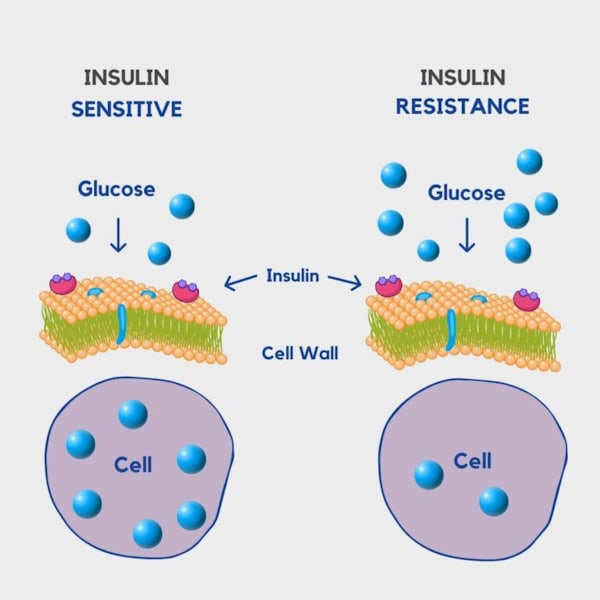
*A person who is insulin-sensitive has no problem pulling glucose from their blood and storing into their muscle cells.
He looked at me and said, half-joking, half-serious:
“Okay… how old are you?”
I said, “I’m 34.”
He genuinely thought I was in my 20s.
That’s when I said, “Let’s just look it up.”
We pulled out ChatGPT right there and asked:
“Does eating added sugar from a cookie cause glycation in an active person in a calorie deficit?”
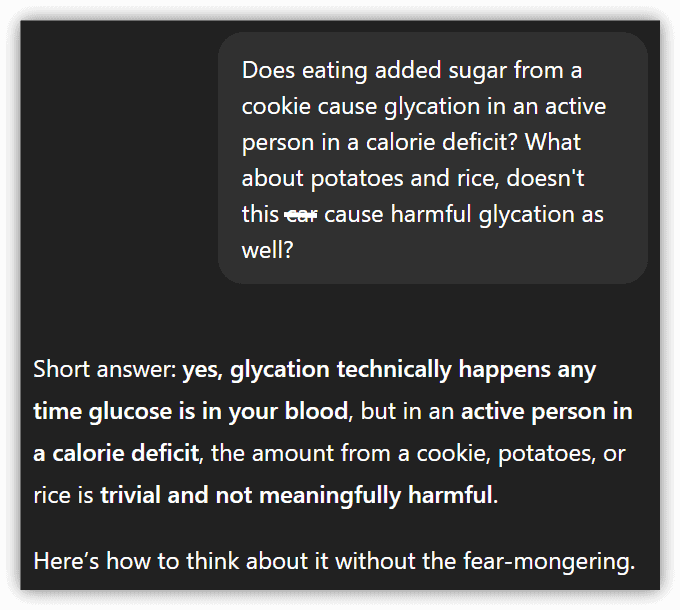
The answer was immediate and clear: It’s “trivial and not meaningfully harmful.”
- Short glucose exposure
- Rapid clearance
- No chronic elevation
- No meaningful glycation
To his credit, he immediately accepted it. No ego. No argument. We moved on and ended up having a great dinner. I actually respected that a lot. And to be clear, he had deep expertise in areas well outside of nutrition.
But the moment highlighted something important.
When people say “sugar,” what they really mean is chronic metabolic dysfunction.
- Get lean
- Stay active
- Eat in a slight deficit or at maintenance
And enjoy your damn cookie.
Here’s the other thing that helps me eat what I want without worrying.
I take Kino Mojo daily.

The ingredients in Mojo help my body operate at a high level, so I don’t have to stress about an imperfect diet.
- Tongkat Ali: Supports healthy testosterone levels and improves insulin sensitivity
- Forskohlii: Enhances metabolic function and supports healthy blood sugar levels
- Boron: Helps reduce inflammation and supports hormonal balance
- Zinc: Critical for immune function and metabolic health
- Magnesium: Improves insulin sensitivity and supports over 300 enzymatic processes
When your hormones are optimized and your body is running efficiently, it can handle a cookie without breaking a sweat.
This is why I don’t obsess over every gram of sugar.
I stay lean, stay active, and let Mojo handle the rest.
Talk Soon,
Greg O’Gallagher
P.S.
The Kinobody Shred Challenge is now open for enrollment.
3 months. Cash prizes. A private community. Weekly coaching calls.
All you need is a Kino App subscription to join.
We kick off February 1st.
If you want to be lean enough to eat cookies guilt-free, this is your shot.