
I’ve been getting questions about the FDA warning linking GLP-1s to sudden blindness.
Let’s look at the actual data.
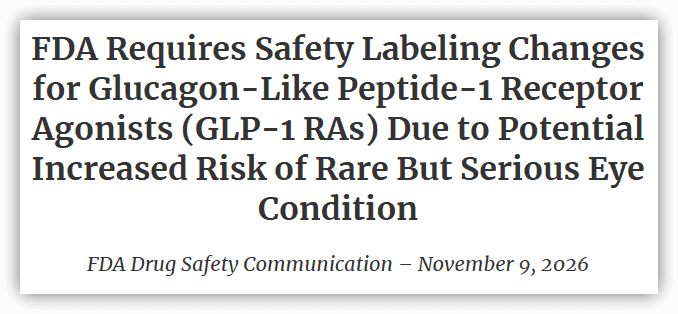
The FDA analyzed 126 randomized trials involving over 134,000 people across multiple GLP-1 medications. [1]
There were just 15 probable cases of NAION (a type of sudden vision loss caused by reduced blood flow to the optic nerve). Ten were in the GLP-1 groups and five were in the controls.
That’s 6.4 versus 3.8 cases per 100,000 person-years.
We’re talking about an exceptionally rare condition, with so few events that it’s difficult to precisely determine the magnitude of any increased risk.
And remember, NAION isn’t random.
It mostly shows up in people with type 2 diabetes, high blood pressure and other metabolic issues, the exact people taking these medications. [2]
Here’s What’s Particularly Interesting
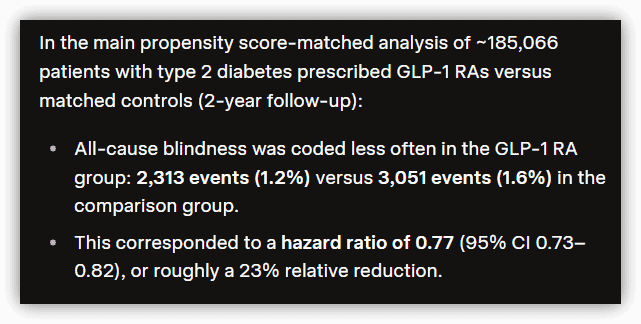
A much larger 2025 study in JAMA Network Open involving over 370,000 patients with type 2 diabetes found a 24.2% lower relative risk of blindness from any cause among GLP-1 users. [3]
Yes, LOWER rates of blindness overall.
The GLP-1 group did have slightly more cases of NAION specifically, but the difference wasn’t statistically significant.
Of course, the FDA is going to be cautious. That’s its job.
But there’s a massive difference between identifying an exceptionally rare potential risk for people with obesity and type 2 diabetes and sensationalizing it as though GLP-1 medications are making people go blind.
Especially when the largest data we have on GLP-1’s and blindness show less blindness in GLP-1 users (the JAMA Network Open).
There’s no statistically proven increase.
It’s extremely rare, and it mostly happens in people who were already at higher risk anyway.
If you’ve been on the fence because of headlines like this, Kino Clinic lets you start the right way, with a provider checking that it’s a good fit for you.
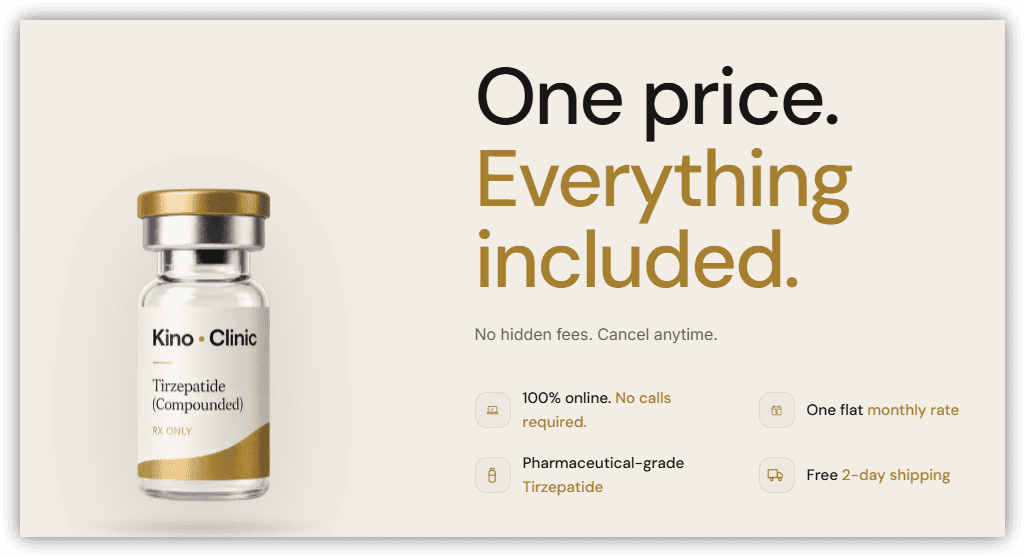
Just fill out a quick online form. A licensed provider reviews it, and if you’re approved, your medication ships out the next day.
Talk soon,
Greg O’Gallagher
P.S.
Kino Clinic just got some big upgrades. Orders now ship out the next day, and pricing is better across the board: the microdose is $169 every 4 weeks, or $149/month on the 3-month supply, and personalized dosing is $199.
Kino Clinic works exclusively with licensed 503A compounding pharmacies to provide physician-prescribed, pharmacy-grade compounded Tirzepatide. All medications are prescribed by licensed physicians for individually identified patients based on documented clinical need. Compounded medications are not FDA-approved finished drug products and are not intended as substitutes for FDA-approved medications such as Mounjaro® or Zepbound®. Individual results vary. This is not medical advice. Use only under the supervision of a licensed healthcare provider.
© 2026 Kino Clinic. All rights reserved.